
“When are we leaving?”
“What time is dinner?”
“Where is Mom?”
You answer the question and a few minutes later, you hear it again.
For caregivers of people living with dementia, repetitive questions can be one of the most challenging parts of day-to-day care. Even when you understand that your loved one may not remember asking the question, hearing it repeatedly can be frustrating and exhausting.
Repetition is a common behavior associated with Alzheimer’s disease and other dementias. A person may repeat the same question, story, word, or activity because they do not remember asking it before, or because they are trying to communicate a concern, seek reassurance, or cope with anxiety or uncertainty.
Understanding why someone with dementia may repeat questions can help caregivers respond with greater patience and find strategies that work for their loved one.
Why Does Someone with Dementia Repeat Questions?
Repetitive questions are often connected to changes in memory and communication caused by dementia. A person may ask a question and genuinely forget that they asked it moments later. Alzheimer’s disease can affect a person’s ability to retain new information, which means an answer that feels recent to the caregiver may not feel recent to the person with dementia.
However, memory loss is not always the only reason. The Alzheimer’s Association notes that repetitive questions may also be a way for someone to express a concern, ask for help, or cope with feelings like frustration, anxiety, or insecurity.
For example, a person repeatedly asking, “When are we leaving?” may not simply be looking for a time. They could be anxious about where they are going or worried about missing something. The question is only part of the communication. Sometimes, the emotion behind the question is more important.
What Should Caregivers Do When Questions Keep Repeating?
There is not a single response that works for everyone or every situation. The best approach may depend on what the person asks, how they are feeling, and what is happening around them.
Here are strategies caregivers can try:
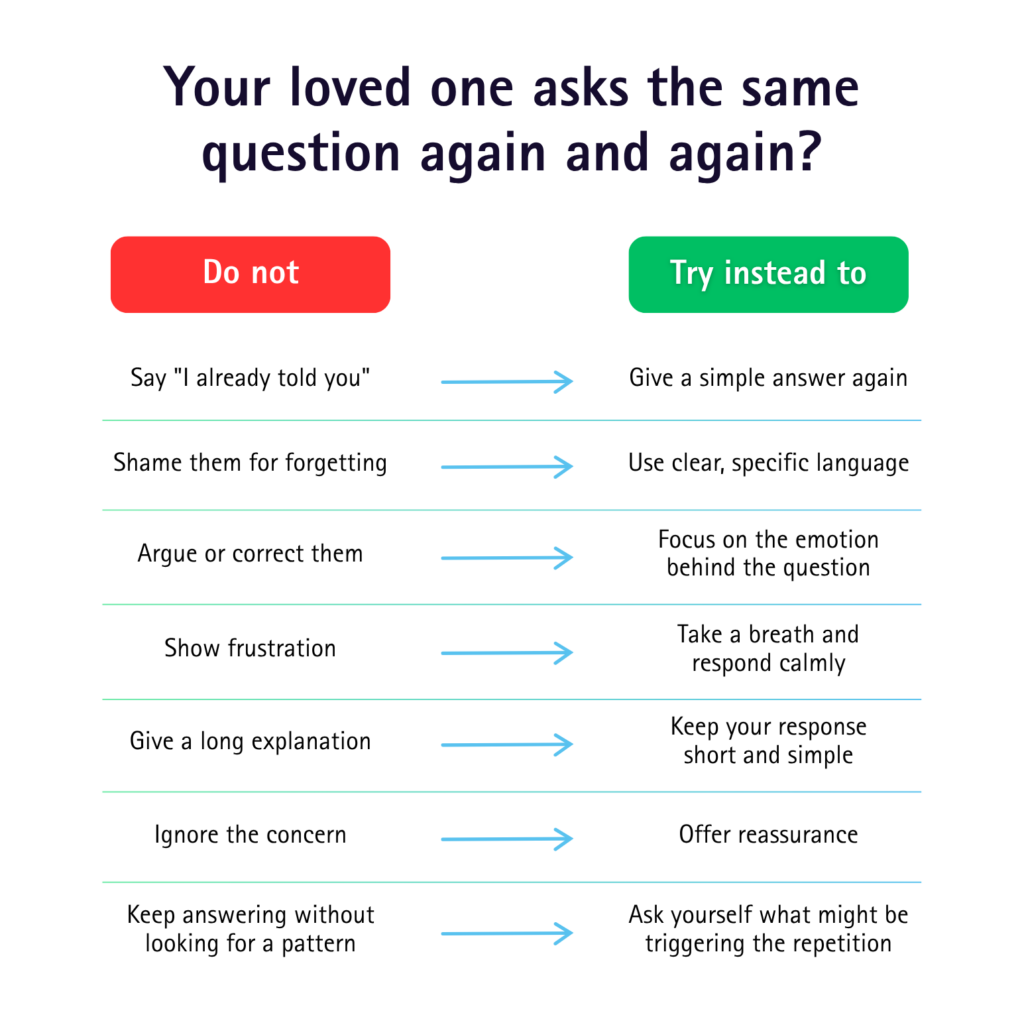
1. Stay Calm and Remember They May Not Know They Have Already Asked
It can be tempting to respond with: “I already told you that.” However, someone with dementia may not remember receiving the answer. The Alzheimer’s Association recommends remaining calm and patient rather than arguing or trying to use logic to explain that the question has already been answered.
Try taking a breath before responding. A calm tone can help prevent frustration from escalating for both of you. You do not have to pretend that caregiving is not difficult. It is OK to recognize that repetitive questions are frustrating while also remembering that your loved one is not necessarily choosing to repeat them.
2. Look for the Emotion Behind the Question
Ask yourself: What might my loved one be experiencing right now? Are they worried? Lonely? Bored? Confused? Needing reassurance? Trying to understand what is happening next?
The Alzheimer’s Association recommends looking for a reason behind repetition and focusing on the person’s emotions rather than simply reacting to the behavior. For example, if your loved one repeatedly asks, “When are you leaving?” they may be concerned about being alone. Instead of only answering the question, you might say: “I am going to be here with you for a while. You are safe.” This addresses the potential concern behind the question while providing reassurance.
3. Answer Simply and Clearly
When someone has difficulty processing information, long explanations may make communication more difficult. Keep your response brief and use familiar language.
The National Institute on Aging recommends speaking clearly, allowing extra time for responses, and using simple questions when communicating with someone who has Alzheimer’s disease.
Instead of: “I told you we are going to the doctor after lunch, and then we are going to stop at the pharmacy before coming home.”
Try: “We are going to the doctor after lunch.” If they ask again, you may simply repeat the answer. You do not need to provide a new explanation every time.
4. Do Not Argue or Try to Prove Them Wrong
When someone asks the same question repeatedly, correcting them may feel like the logical response. However, dementia can make it difficult for a person to retain the information you’re using to correct them.
The Alzheimer’s Association and NIA both recommend avoiding arguments and criticism during communication with someone living with Alzheimer’s disease.
5. Try a Memory Aid
For questions about schedules, appointments, or upcoming activities, a visual reminder may help.

Depending on the person’s abilities, try:
- A large clock
- A simple calendar
- A written schedule
- A note posted in a familiar location
- A whiteboard with the day’s activities
- Photographs of people or places that are part of the person’s routine
The Alzheimer’s Association recommends memory aids such as notes, clocks, calendars, and photographs when they are still meaningful and understandable to the person. A visual reminder will not eliminate repetitive questions, but it may give the person another way to find information independently.
6. Redirect to Something Meaningful
Sometimes answering the question is not enough to break the cycle of repetition. If the person continues asking, try redirecting their attention to a familiar activity.
The Alzheimer’s Association recommends engaging the person in an activity, particularly if boredom may be contributing to the repetitive behavior. The activity must match the person’s interests and abilities.
Try:
- Looking through a photo album
- Listening to familiar music
- Taking a walk
- Folding towels
- Watering plants
- Watching a favorite television program
The goal is not to distract them simply to make the questions stop. A meaningful activity can provide connection, comfort, and a feeling of purpose.
7. Look for Patterns
If the same question keeps coming up, pay attention to when and where it happens.
Does your loved one ask repetitive questions:
- At a particular time of day?
- Before leaving the house?
- When a particular person leaves?
- When they are tired?
- In a noisy environment?
Examine whether repetition occurs around certain people, settings, or times of day. If repetitive questioning suddenly becomes much more frequent or is accompanied by a noticeable change in confusion, agitation, sleep, mood, or physical health, talk with a health care provider. A sudden change in behavior may have an underlying cause that needs attention. Pain, illness, medication changes, sleep problems, and other factors can affect behavior and communication.
Make Space for Your Own Well-Being
Repetitive questions can be emotionally exhausting. Even when you understand that your loved one cannot control the behavior, answering the same question repeatedly can test your patience. Feeling frustrated does not make you a bad caregiver.
If you notice yourself becoming overwhelmed, step away for a few minutes when it is safe to do so. Ask another family member or caregiver to take over when possible. Give yourself permission to take breaks. Caregiving is demanding, and you do not have to handle every moment perfectly.
If repetitive behaviors are becoming difficult to manage, consider talking with a dementia care professional, support group, or health care provider. Getting support can help you find strategies that work for your family and give you a place to talk about the challenges of caregiving.
Sources:
Alzheimer’s Association. “Repetition.” https://www.alz.org/help-support/caregiving/stages-behaviors/repetition
Alzheimer’s Association. “Communication and Alzheimer’s.” https://www.alz.org/help-support/caregiving/daily-care/communications
National Institute on Aging. “Communicating With Someone Who Has Alzheimer’s Disease.” https://www.nia.nih.gov/health/alzheimers-changes-behavior-and-communication/communicating-someone-who-has-alzheimers
National Institute on Aging. “Do’s and Don’ts: Communicating With a Person Who Has Alzheimer’s Disease.” https://www.nia.nih.gov/health/alzheimers-changes-behavior-and-communication/dos-and-donts-communicating-person-who-has