
Caring for a parent or loved one with dementia is tough enough. When you add in multiple adult children (i.e., siblings) who may hold differing opinions about what is “best,” the situation can become emotionally charged or even harmful to the relationships of those involved. Research shows that sibling conflict in caregiving settings is a secondary stressor, which is yet another negative impact on the caregiver beyond the direct care burden. Disagreements about decisions, roles, and responsibilities add significantly to overall stress and can erode both relationships and care quality for the person living with dementia.
Below are six actionable strategies for navigating sibling disagreements in dementia care—each paired with research or source references and implementation tips.
1. Clarify and agree on the shared purpose – the “why” of care
Start by coming together (virtually or in-person) and articulating, in writing if possible, the overarching goal for your loved one: his/her safety, dignity, quality of life, staying at home as long as possible, etc. A shared purpose becomes a reference point when decisions differ.
Why this matters: In a study of siblings caring for a parent with dementia, one identified theme was “the goal of shared caregiving is to meet parents’ needs.” When the goal is shared, sibling efforts are more likely to align.
Implementation tip:
- Facilitate a short “family meeting” (see #3) and pose: What matters most to Mom right now? How do we define success in the next 3–6 months?
- Capture answers in bullet format and circulate to all siblings.
- Revisit it every 3–4 months (or when major changes happen).
2. Map roles, responsibilities, and capacities
Often conflict arises because one sibling feels they are doing more or another is perceived as “outsider” and not contributing. Research indicates these imbalances (time, distance, skills) play strongly into sibling difficulties.
Implementation tip:
- Create a “care map” or spreadsheet that lists tasks (medications, doctor visits, errands, finances, respite setup) and assign names, frequency, and backups.
- Include a column: Who is best placed? Sometimes a sibling who lives farther away can take tasks like researching services or handling insurance.
- Recognize capacity: If one sibling has more bandwidth, others can still support in lesser-seen ways (phone check-in, monthly oversight).
3. Hold regular, structured family meetings
According to the Family Caregiver Alliance, having a consistent, structured forum for communication can prevent resentments, assumptions, and the “invisible carry-load” going unspoken.
Implementation tip:
- Set a recurring monthly or bi-monthly video/phone meeting.
- Send an agenda ahead of time (30 minutes or less): e.g., updates from primary caregiver, new challenges, decision needs, finances, siblings’ roles.
- Use a facilitator if needed (see #5).
- Keep minutes: who agreed to what, deadlines, next meeting date.
4. Use objective data and third-party input
When opinions differ (e.g., “Should we move Mom into assisted living?”), introduce objective data: medical assessments, care-facility tours, cost comparisons, home-safety evaluations. This shifts discussion from “my opinion vs. yours” into “what the facts show.”
Why this helps: According to the Institute on Aging, conflicts often center on “money, opinions of treatment, who does how much.”
Implementation tip:
- Invite the primary caregiver and at least one sibling to attend a home-care or dementia-care professional consultation together (virtually if necessary).
- Ask for a simple report or summary of options (with pros/cons).
- Distribute the summary ahead of decision meetings so everyone has time to review.
5. Bring in a neutral facilitator when needed
Sometimes a sibling meeting becomes emotionally charged, stuck, or driven by unresolved past dynamics (siblings’ rivalries, perceived favoritism, etc.). A neutral facilitator (social worker, elder-care mediator, trusted family advisor) can help keep the focus on the loved one and the shared goal rather than sibling history.
Implementation tip:
- Agree in advance (with all siblings) to engage third-party facilitation if no consensus is reached after two meetings.
- Choose someone with elder-care knowledge or mediation experience.
- In the meeting, the facilitator helps ensure all voices are heard, ground rules are followed, and decisions are documented.
6. Practice intentional communication and manage expectations
Sibling caregivers report that feeling criticized by siblings is a major stressor—and these perceptions are shaped in part by gender and family structure. For example, daughters in sibships with more sisters are more likely to perceive criticism.
Implementation tip:
- Use “I” statements rather than blaming: “I feel overwhelmed when…” vs. “You never help.”
- Acknowledge the reality of caregiving fatigue, guilt, and emotional load—these impact every sibling differently. (Alzheimer’s Society)
- Set clear expectations: If a sibling cannot help weekly with hands-on tasks, define what they can do (e.g., monthly check-in calls, coordinating services).
- Encourage siblings to give each other grace—remember to keep the well-being of the person with dementia front and center.
Caregiving for someone with dementia is a marathon, not a sprint. When siblings band together, there is more capacity, more resilience—but only if the caregiving team’s inter-relationships remain healthy. By clarifying shared goals, mapping roles, scheduling communication, grounding decisions in data, engaging facilitation when needed, and communicating with empathy, your caregiving network can function more smoothly and sustainably.
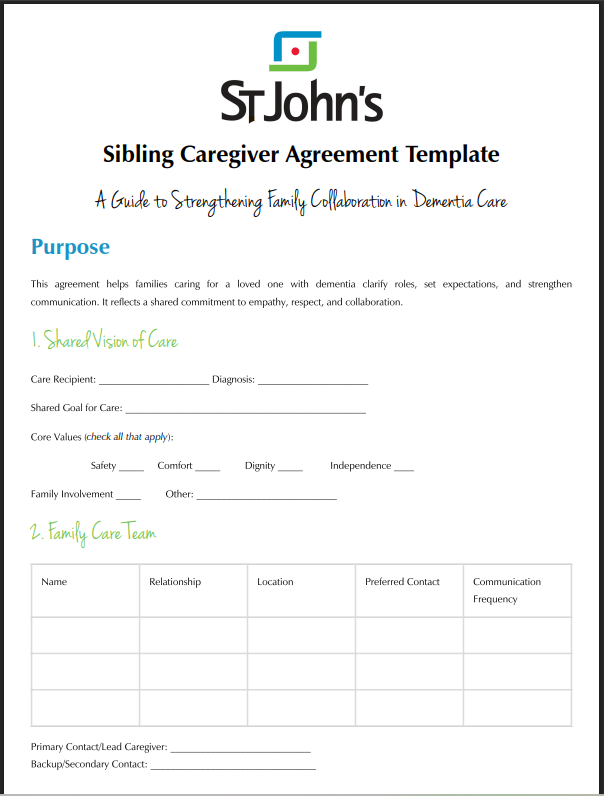
Download St. John’s Family Caregiver Agreement Template to create your family’s agreed upon relationship guide for caring for your loved one with dementia.